Knowing how something works is not the same as being able to do it
Sara Farwell and Matt Zatonski’s session at IDTX last Friday was built around a deceptively simple problem: we’ve got very good at helping people feel like they’ve learned something, and much less good at helping them actually change what they do.
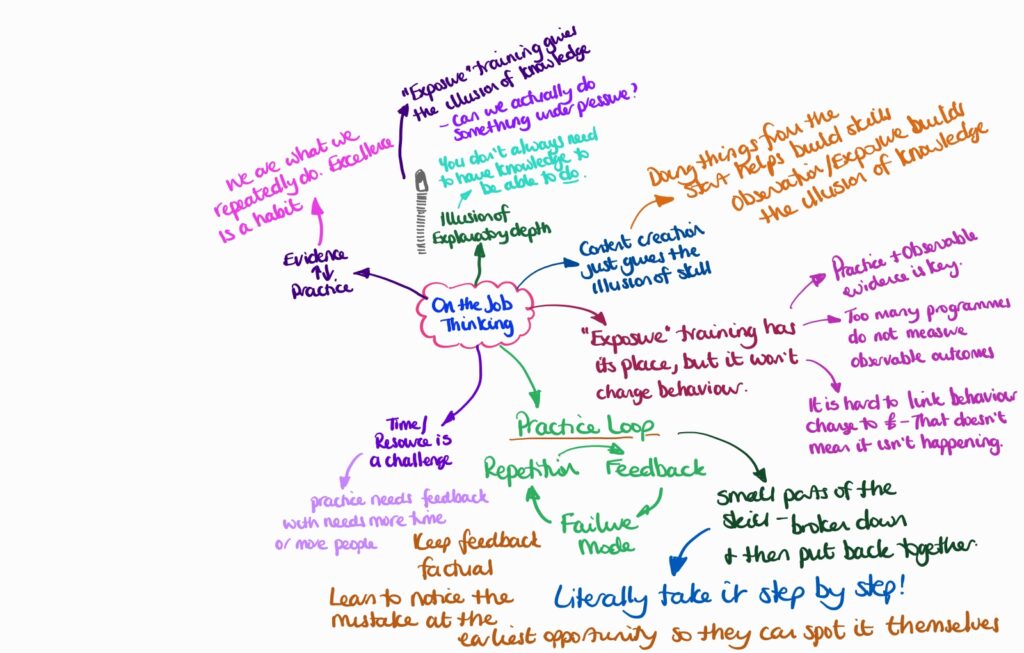
There’s a name for the gap between the two. It’s called the illusion of explanatory depth, the tendency to believe we understand something until the moment we’re forced to explain it, at which point we discover we understood it much less than we thought. Most people can describe broadly how a zipper works. Very few can explain the mechanism accurately. The familiarity is real. The understanding isn’t quite.
This matters in L&D because familiarity with an idea can feel indistinguishable from being able to apply it. Someone who has sat through a session on feedback models might feel reasonably confident about their ability to give good feedback. Until they’re actually in the room with someone.
How many of us has been facilitating sessions where managers say “I know all this!” – yet they’ve been asked to attend training (again) because they don’t actually DO it? Knowing and doing are not the same.
Exposure builds the illusion, not the skill
The session’s core argument was this: exposure training, watching, reading, listening, completing an e-learning module, builds the illusion of knowledge. It doesn’t build the capability.
There’s a similar phenomenon with observational learning. Watching someone do something well, whether that’s a demonstration in a training room or a video on demand, tends to make us feel more confident about our own ability to replicate it. But that confidence isn’t matched by actual performance. The two come apart quickly when the conditions get real.
This has practical implications for how we design and measure. How many programmes include a healthy dose of observation, discussion, and content, and then measure completion? Completion tells us people were present. It doesn’t tell us anything about whether they can do what the programme was designed to develop.
The practice loop
The alternative that was described isn’t complicated, but it is demanding. Genuine skill development requires practice, specifically, deliberate practice with feedback. Not just repetition, but repetition with the opportunity to notice mistakes at the earliest possible point and correct them.
The model they outlined was a practice loop: repetition, feedback, and failure mode, meaning the deliberate exploration of where things go wrong, so learners can start to recognise and self-correct. The skill you’re developing gets broken into its component parts, worked through in sequence, and only then put back together.
The feedback in this model needs to be factual rather than motivational. ‘That was great, keep going’ doesn’t give a learner anything to work with. ‘Your opening question closed down the conversation, here’s what happened and why’ does. The goal is self-correction, not reassurance.
The resource problem is real
The speakers didn’t pretend this is easy to deliver. Deliberate practice at this level requires time: time we usually aren’t given as stakeholders want training to be over and done with as quickly as possible. It also requires other people; more facilitators, a coach, a peer, a manager who knows what good looks like and can give useful feedback in the moment. Those things are always in short supply.
But there’s a cost to the alternative too. Programmes that produce the feeling of learning without the capability to perform are a poor use of resources, for the organisation, and for the learners who sit through them and leave more confident, but no more able than when they arrived.
The honest question is whether we’re measuring what’s easy to measure (attendance, completion, immediate reaction) rather than what actually matters (whether people can do something differently, and do it under pressure). Linking behaviour change to financial outcomes is genuinely hard, so we need to be more deliberate about defining what observable change looks like before we start, not after.
Key thought…
The thing that stuck with me was the distinction between awareness training and skills development. Both have a place, but only the latter reliably builds skill. Observation builds familiarity. Familiarity feels like competence. It often isn’t.
That’s a useful thing to remember when a client asks for a course and you know what they probably need is a practice environment.
Session: On-the-Job Thinking: Critically thinking through the evidence at work, Sara Farwell & Matt Zatonski | IDTX, Birmingham, May 2026
You must be logged in to post a comment.