You can teach someone everything about climbing a mountain. They still might never climb one.
That image, from Kurt Ewald Lindley’s session at IDTX last Friday, is the one I keep coming back to. This session in particular, brought together a lot of the pieces I already had and helped me to form them into a coherent whole.
The session started by asking us to imagine someone who wants to climb a mountain. Not a small hill, a real one, the kind that tests you. You can teach them everything: altitude, weather systems, equipment, the risks involved. Your instruction is clear. Your examples make sense. They seem to understand it all.
And yet they never climb.
Lindley’s argument is that this is the quiet problem at the heart of a lot of learning design. We’ve become genuinely skilled at helping people pay attention and understand. We’re far less effective at helping them act, apply, and change. And those two things, understanding and doing, are more separate than we tend to assume.
The step we don’t design for
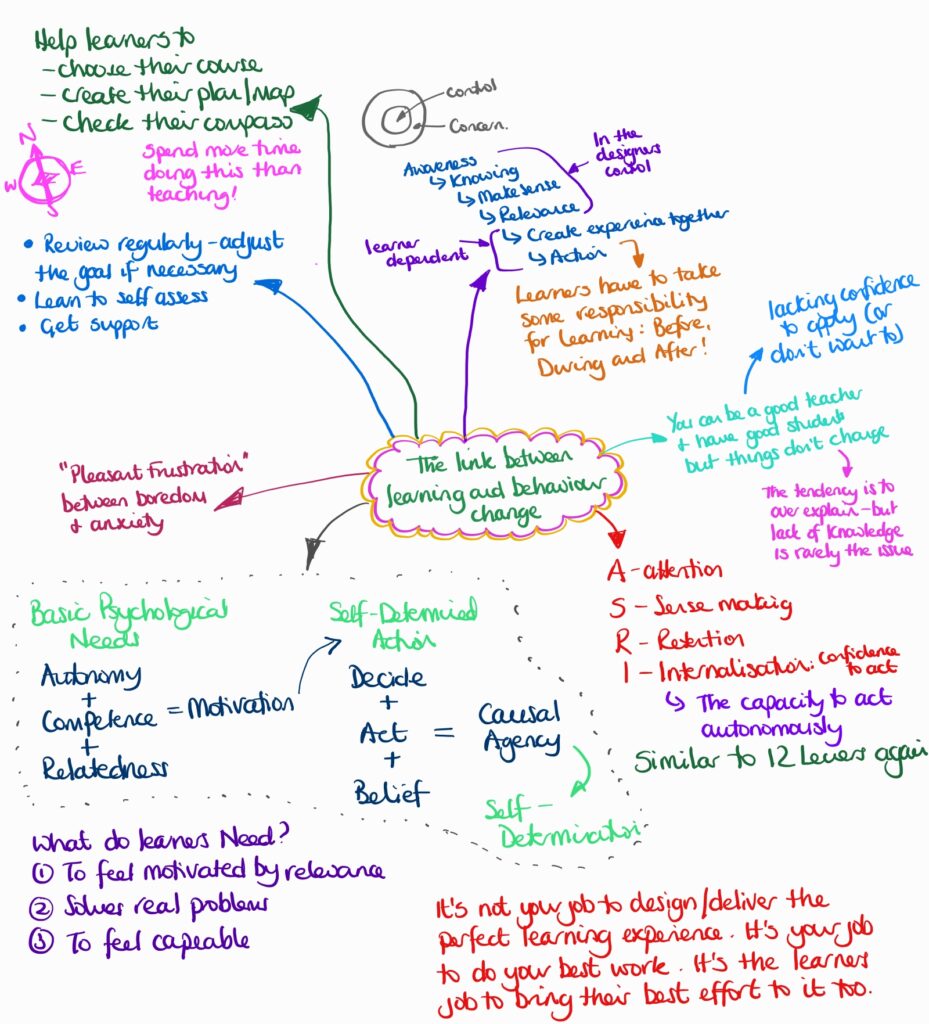
The session centred on what Lindley called causal agency: the capacity to act as the agent of your own change, rather than a passive recipient of someone else’s programme. He framed this through three elements.
Did the learner choose this, is the goal genuinely theirs?
Are they taking purposeful steps towards it?
Do they believe their effort can actually lead somewhere?
If any of those three are missing, the learning tends to stay theoretical. The person understands, nods, completes. And then returns to the workplace and does more or less what they always did, because nothing in their internal landscape has shifted enough to generate different behaviour.
This connects to a model Lindley uses called ASRI, Attention, Sense-making, Retention, and Internalisation. The first three stages are where most of our design effort goes. We plan for attention (how do I get people engaged?), sense-making (how do I make this clear and relevant?), and retention (how do I help people remember?). These are legitimate questions and worth asking.
But the fourth step, internalisation, is where the real transformation happens, and it’s the one we tend to design least deliberately for. Internalisation isn’t just about remembering. It’s about whether learning has become part of how someone thinks, decides, and acts. Whether they’ve developed the capacity to act autonomously and proactively, rather than just responding when prompted.
Why adding more content doesn’t fix this
The instinct in L&D when transfer isn’t happening is often to add more. More content, more explanation, more scenarios, more support materials. However, lack of knowledge is rarely the actual barrier.
The barriers tend to be confidence, relevance, and ownership. Does this person believe they can do this? Does it connect to something they genuinely care about? Do they feel any ownership over the goal, or is this entirely something being done to them?
You cannot, as Lindley put it, explain people to the summit. They have to take the journey themselves.
The role of the practitioner
We were reminded that the goal isn’t to design or facilitate a perfect learning experience. It’s to create conditions in which the learner can do their best work, and then trust that it’s the learner’s responsibility to bring their best effort to it. That’s not a way of abdicating responsibility. It’s a more honest description of what we can and can’t control.
Practically, this means spending more time helping learners choose their own direction, build their own plan, and check their own progress, and less time covering content. Spending more time in what Kurt called ‘pleasant frustration’, the zone between boredom and anxiety where genuine challenge lives, rather than designing for comfort or smooth completion.
It also means taking internalisation seriously as a design criterion. Not just: will they remember this? But: will they feel capable of using it without me?
There are clear links between what he discussed and the 12 levers of Learning Transfer, which is a concept that I found myself referring back to more than once throughout the whole day.
What I noticed…
Talking to a few people after the session, the response was a fairly consistent version of ‘this is obvious when you say it, and yet…’ And yet our programmes don’t often reflect it. Action Planning is included of course, but is it structured? Do we allow enough time for it? Do we work with people to make it personal and help them to plan every step? Usually no.
And yet THAT’S what can often make the biggest difference.
Session: Promoting Causal Agency: the missing link between learning and behaviour change, Kurt Ewald Lindley | IDTX, Birmingham, May 2026
You must be logged in to post a comment.