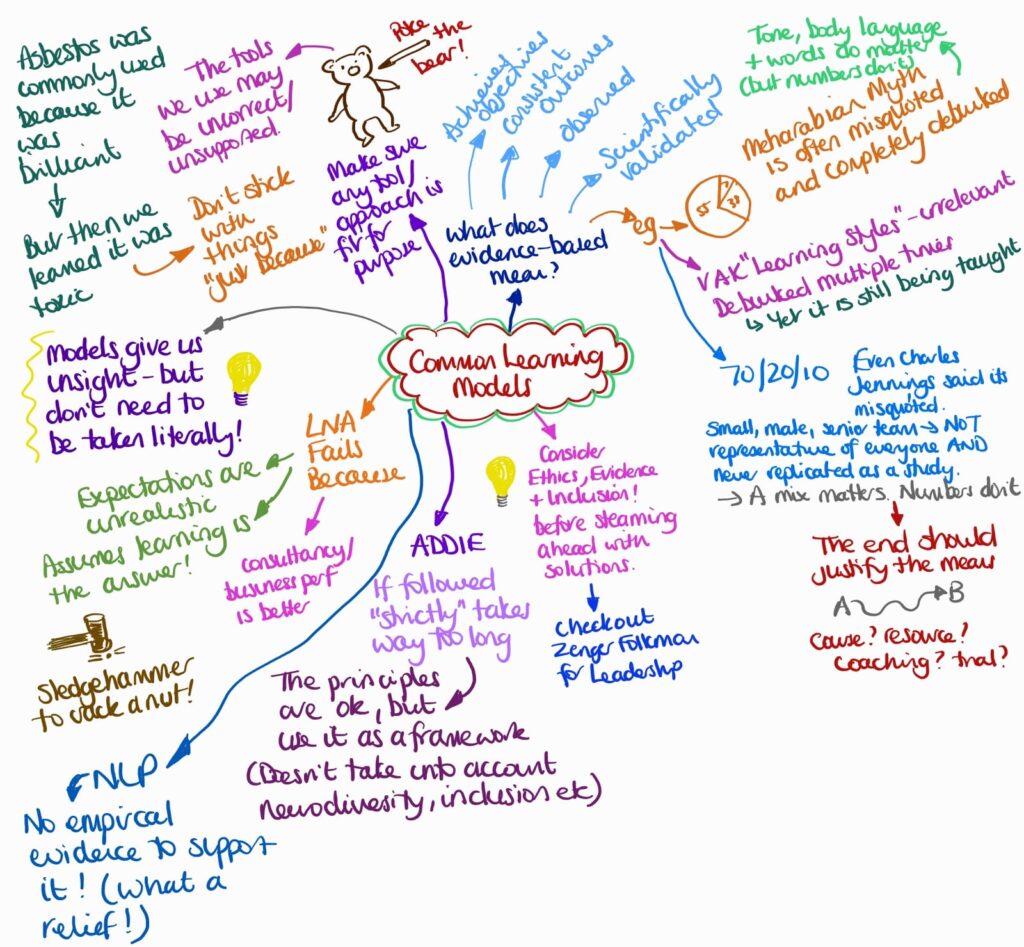
Sukh Pabial asked a question that sounds simple but isn’t: when we say a tool or approach is evidence-based, what do we actually mean by that? It’s a question worth considering, because if we’re honest, most of us take things at face value. We adopt models that feel right, that were taught to us by people we respected, that our clients favour, or that our organisations have been using for years. And we carry them forward without going back to source and questioning the validity.
The ones we need to talk about
Sukh walked through several frameworks that are still widely used across our field, and in each case, asked what the evidence actually shows.
VAK learning styles: the idea that people learn better when content is matched to their preferred sensory mode (visual, auditory, kinesthetic). It’s been used in schools, coaching, and L&D programmes for decades. It’s also been debunked repeatedly. There is no reliable evidence that matching instruction to a preferred style improves learning outcomes. And yet it persists, because it feels intuitively true and people find it useful as a conversation starter.
The Mehrabian 55/38/7 rule: the idea that 55% of communication is body language, 38% is tone of voice, and only 7% is the words. Almost universally misquoted and misapplied, Mehrabian’s original research was about communicating feelings and attitudes in a very specific context, not a general rule about all communication. Tone, body language, and words all matter. The percentages don’t. His wonderful demonstration illustrated the nonsense of this perfectly.
70/20/10: a useful nudge towards the idea that development happens through experience and relationships as much as formal training, but the original research was based on a small, senior, non-representative sample. Charles Jennings, who’s often credited with bringing it to wider attention, has said it’s been misquoted and over-applied. It describes a rough pattern, not a prescription for learning design.
NLP (Neuro-Linguistic Programming): no empirical evidence to support its effectiveness. Richard Bandler and John Grinder didn’t develop NLP through the sort of large-scale experimental research that would typically be expected in psychology. Instead, they studied a small number of people they considered exceptionally effective communicators and therapists. They proposed links between language, behaviour and neurological processes, but these were largely theoretical rather than based on neuroscience research.
This isn’t about tearing things down
The point of the session wasn’t to leave us feeling foolish for having used any of these. Models give us ways of thinking and talking about complex things. That’s genuinely useful. The problem isn’t using a model, it’s forgetting that a model is a simplification, treating it as settled science, or continuing to use it after the evidence has moved on.
He used the example of ADDIE as a case in point. It was created to help design training for the military in the 1970s. If you go back to the original documents, it is of course outdated. However, I personally believe that ADDIE is still useful if used as a general framework, not a prescription to follow. 5Di is a perfect example of how the model has been updated. Our knowledge improves; our environments change; we have to adapt, evolve and re-evaluate.
We were encouraged to think about the difference between myths (simply not true), misconceptions (partially supported, but misapplied), and superstitions (known to lack support, but used anyway). Most of the frameworks above sit in the third category. We know, or could easily find out, that the claims don’t hold up. But we keep using them because they’re familiar, they’re liked, because they’ve been built into our processes, or because challenging them feels like a bigger conversation than the moment allows.
The asbestos analogy
Suhk compared the persistence of debunked frameworks to asbestos, for a long time, a perfectly sensible building material. The problem wasn’t the people who used it back in the day; it was continuing to use it once we knew better. That’s a fair challenge to us. We’re not the first generation to have used VAK or 70/20/10. But we probably are the generation that has good enough access to the evidence to stop doing so uncritically.
A practical question to take back
His test was fairly simple: before using a model or tool, ask whether it achieves consistent, observable outcomes, and whether you can justify using it. That doesn’t require a PhD in research methods. It requires the habit of asking the question, and being willing to hear a difficult answer.
And before steaming ahead with a solution, he suggested pausing to consider ethics, evidence, and inclusion together, not as separate boxes to tick, but as a combined sense-check on whether what you’re doing is actually fit for purpose.
I still do refer to some ‘outdated’ models from time to time, but I always include a health warning. It’s clearly something that I need to be braver about.
Session: An evidence-based look at common learning models, Sukh Pabial | IDTX, Birmingham, May 2026
You must be logged in to post a comment.