
Motivation gets people in the room. Then what?
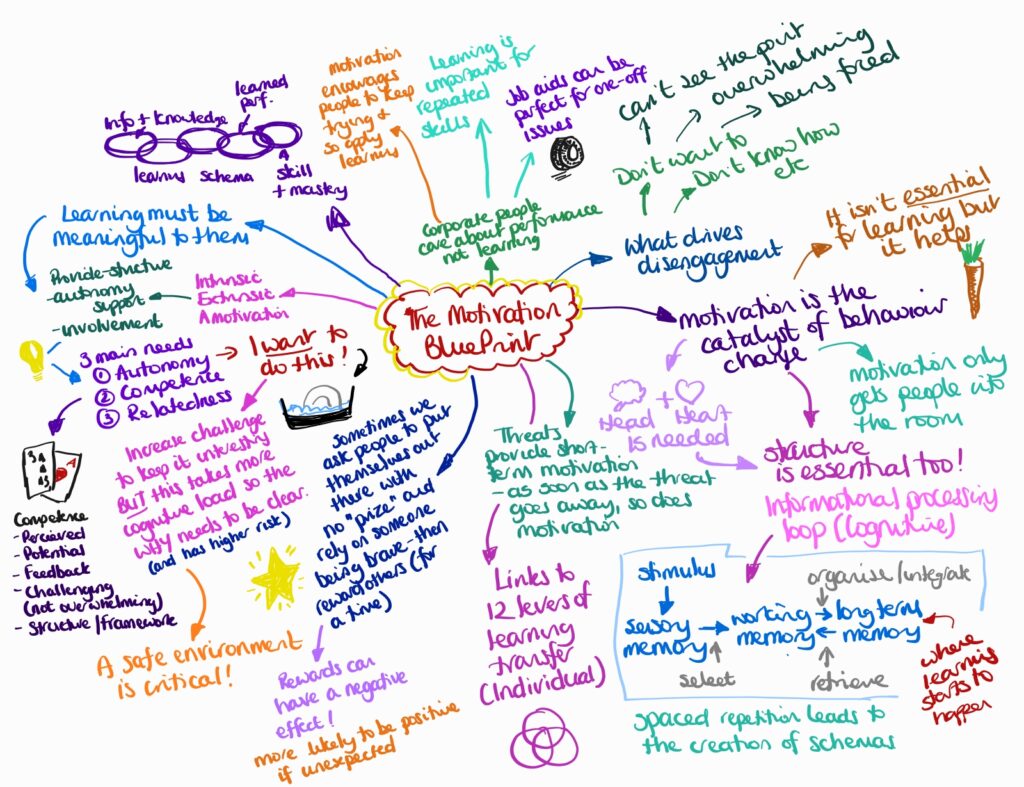
Matthew Richter’s session on the Motivation Blueprint focused on the distinction between motivation as a catalyst and motivation as a mechanism for change. They’re not the same thing. Motivation, Richter argued, is what gets people through the door. It doesn’t keep them there, and it certainly doesn’t guarantee they’ll do anything differently on Monday morning. That responsibility falls somewhere else entirely.
The three types, and why amotivation matters
Motivation was framed across three broad types: intrinsic (driven by genuine interest or personal meaning), extrinsic (driven by external rewards, recognition, or pressure), and amotivation, which is essentially the absence of motivation altogether. Not demotivation, just no engagement, no investment, no reason to try.
We tend to focus our design energy on the first two and hope the third doesn’t apply to our learners. In practice, it often does, particularly in mandatory programmes where people genuinely can’t see the point.
What actually supports motivation
The most useful part of the session, for me, was the focus on creating the conditions for motivation (Because that’s what’s within our circle of control). For motivation to take hold and persist, people generally need three things:
- a sense of autonomy (I’m choosing this, or at least I understand why it matters to me)
- competence (I can do this, or I’m making progress towards being able to)
- relatedness (this connects to other people and to something I care about).
These three come from self-determination theory, the work of Deci and Ryan, and they’re a more practical lens than trying to create intrinsic motivation directly.
The session explained that threats undermine all three. They create short-term compliance, but the moment the threat goes away, so does the behaviour. We’ve all seen this. Compliance training is the obvious example, but it shows up in performance management contexts, onboarding, and anywhere else where the implicit message is ‘do this or else.’ People do the bare minimum to tick a box, but behaviour doesn’t change.
Rewards are more complicated. They’re not inherently bad, but we have to be careful how we use them. Inviting Penny (one of our VIP members) to sing solo in front of the whole group, and then offering a reward to the next person proved that. We have to be fair and they’re more likely to help when they’re unexpected. The moment you build a reward structure into a programme, you’ve effectively told people what the point is, and it isn’t the learning.
Safe enough to try
One thing that was emphasised is that a safe environment isn’t a nice addition to good design. It’s a prerequisite. If people don’t feel safe enough to try something, get it wrong, and try again, you haven’t got a learning environment at all. You’ve got a performance one, and the two require very different conditions.
This came up in a few sessions across the day, actually. The idea that we often ask people to put themselves out there, to practise in front of others, to attempt something new, to admit they don’t know, without sufficiently considering what that costs them. Bravery in the room only happens when the environment earns it. And real learning needs people to be brave.
Cognitive load and the why
One practical tension highlighted was that increasing challenge keeps people engaged and builds genuine competence, but higher challenge also increases cognitive load. We know from learning science that there’s no learning without challenge, but the more complex the task, the clearer the rationale needs to be. Why am I doing this? Why now? Why in this way? If learners can’t answer those questions, the challenge becomes stressful rather than a stretch, and they give up.
That feels like a useful design checkpoint. Not just ‘is this challenging enough?’ but ‘have I made the case for this challenge clearly enough that learners will push through the difficult bits rather than disengage?’
What I’m taking away
Motivation isn’t something we can create. We can’t make people want to learn, but we can remove the conditions that make learning feel pointless, unsafe, or irrelevant. That’s a more honest framing of what good learning design actually does, and it shifts the question from ‘how do I motivate my learners?’ to ‘what barriers to motivation to learn do we need to remove?’
You must be logged in to post a comment.