The link between learning design and other live experiences
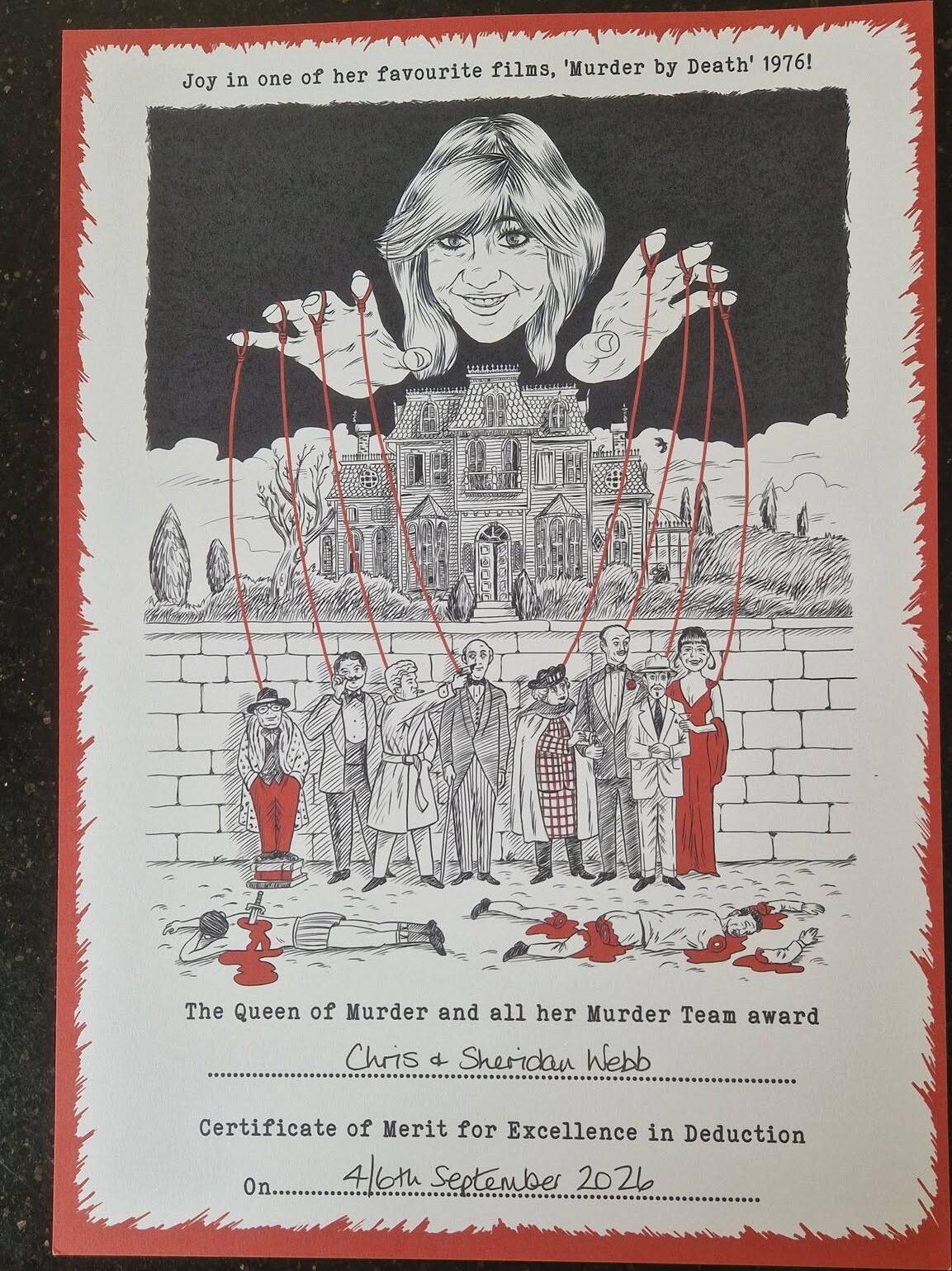
This weekend, my husband and I solved a murder.
Not a real one, obviously. It was a Joy Swift Murder Mystery Weekend, something we first tried 30 years ago. We took a fairly lengthy hiatus while we were busy having and raising children but, since Covid, we’re back!
We don’t always get everything right. In fact, there are usually several clues that make perfect sense only after the solution has been revealed. But we generally manage to work out the key themes and motives, and sometimes (like this time) actually solve the murder!
What struck me over the weekend – and not for the first time, was the sheer skill involved in making the whole thing work.
This isn’t a two-hour dinner where actors appear between courses, deliver a few scripted scenes and then disappear. The mystery begins at 8.00 pm on Friday and continues until 11.00 am on Sunday. It’s complex, multi-layered, with multiple murders, with evidence being released at different times. Throughout that time, the actors remain in character.
Guests can approach them, question them and challenge their version of events. We can follow them around, interrupt conversations and ask about something that happened years before the fictional murder took place. Different guests notice different things and pursue completely different lines of enquiry.
So even though the plot is the same for 4 months, every weekend is different: The characters might be played by different actors. The guests certainly won’t ask the same questions. Nobody can predict exactly where a conversation will go.
So, the actors have to improvise, but they can’t simply say or do whatever feels right in the moment.
Improvisation within boundaries
Each actor needs to remain true to their character, including their personality, relationships, motivations and back story. More importantly, they need to remain true to the plot.
One actor can’t suddenly invent an event that contradicts somebody else’s story. They can’t reveal an important fact before the guests are supposed to discover it. Nor can they respond to an unexpected question in a way that sends everyone down a completely false path or makes a later clue meaningless.
This means they can’t just know their own part.
They need to understand how their character fits into the wider story. They need to know enough about everyone else’s role to recognise what they can safely say, what must remain hidden and what could affect something that happens later.
The experience is multi-layered. There are written clues, conversations and significant events to pay attention to. There’s also a fancy-dress evening, and sometimes the actors’ costumes contain subtle clues too. Something that appears to be a small decorative detail may turn out to be rather more important.
There is an enormous amount of freedom in how the actors interact with guests, but that freedom sits inside a carefully designed structure.
Being a part of it made me think about training programmes designed for other people to deliver.
Detailed facilitator notes are not scripts
There can be a concern that detailed facilitator notes will restrict an experienced facilitator.
I understand where that comes from. Nobody wants to feel that they are reading somebody else’s words from a page or following instructions so rigidly that they can’t respond to the people in front of them. That’s good for no-one.
But there is a difference between prescribing exactly what a facilitator must say and giving them the information they need to make good decisions. Strong design doesn’t have to reduce facilitator autonomy. Done well, it increases it.
When facilitators understand the purpose of a session, how the activities support that purpose and where the session fits within the wider programme, they are in a much better position to respond naturally.
They can explore a useful question that the designer hadn’t anticipated. They can offer an example that makes the subject more relevant to that particular group. They can spend a little longer on something the delegates are finding difficult or shorten an activity when the point has already been made.
In other words, it reduces mental load and allows them to use their professional judgement. But they can do that safely because they know what has to remain intact.
Facilitators need to know more than their own workshop
This becomes particularly important when several facilitators are delivering different parts of the same programme. If I’m delivering workshop two, I need to know what happened in workshop one and what is coming in workshop three. Otherwise, I might repeat an exercise the group has already completed. I might introduce a model that another facilitator is supposed to explore in depth later. I could answer a question in a way that undermines an important activity or reveal something that participants were meant to work out for themselves.
None of those decisions would necessarily be bad in isolation. The content might be useful and the exercise might be excellent. It is the effect on the whole learning experience that creates the problem. A strong workshop can still disrupt a programme if it repeats, contradicts or prematurely introduces something that belongs elsewhere.
Sequence, connection and purpose matter.
This is why facilitators need more than a set of slides and a list of timings. They need enough of the programme’s back story to understand how their part contributes to the whole.
Training design includes more than the content
Joy Swift is now in her 45th year of creating these murder mystery weekends, and her plots are extraordinarily detailed. That detail doesn’t prevent the actors from improvising. It is what makes meaningful improvisation possible. The writing establishes the characters, relationships, significant events, essential clues and boundaries of the story. It gives the actors a shared understanding of the fictional world they are working within.
They know where they have flexibility and where they don’t. They know when they need to work closely with their fellow actors and when they can act independently. Because the foundations are secure, they can concentrate on responding to the guests and making the experience feel real.
Of course, full credit also belongs to the actors. A good design still relies on skilled people to interpret it, bring it to life and make sensible decisions in the moment.
The same is true of training.
Facilitator notes can’t replace judgement, or the ability to read a room. Nor should they try to. But expecting facilitators to work everything out for themselves isn’t a sign that we trust their expertise. Sometimes it simply means we haven’t given them enough information to do the job well.
What should detailed training design include?
I’m often asked, “How detailed should the facilitator notes be?” and it’s a fair question, but a more useful question might be “What does the facilitator need to know in order to deliver this to achieve the desired outcomes?”
That might include:
- The purpose of the workshop and its place in the wider programme
- What participants have already experienced and what they will cover later
- The learning purpose behind each section and activity
- Clear instructions for setting up, introducing and running each activity
- Guidance on how to debrief activities and connect them to the intended learning
- Suggested questions to ask, including useful follow-up prompts
- Likely responses, misunderstandings or issues that may emerge
- The points facilitators should listen for and gently steer discussions towards
- The key learning points that must be drawn out
- Guidance about what can be shortened, adapted or omitted if time is tight
- Suggestions for alternative activities or approaches for different group sizes, timings or delivery methods
- Realistic timings, including time for instructions, questions, discussion and debriefing
- The materials, equipment and preparation each activity requires
- Links and transitions that help the different sections feel like one coherent session
- The areas where facilitators are encouraged to add their own experience and examples
- The elements that shouldn’t be changed, omitted or introduced early
- The assumptions and design decisions that shaped the session
This isn’t about controlling every sentence or anticipating every possible situation. That would be impossible, and probably unpleasant to deliver. It is about distinguishing between the things that hold the learning experience together and the things that can flex around the needs of the people in the room.
Any decent facilitator will read these detailed notes carefully and then distil everything into their own shorter version to guide them on the day. The full version can be referred to in the breaks. Just as the actors didn’t walk around with the script, which I’m assuming runs to dozens to pages, relying instead on a few key points on their phones.
I’ve written before about designing training for other facilitators and why a slide deck on its own is rarely enough. I’ve also explored the reasons for designing training in detail and the important distinction between training preparation and training design.
The distinction matters. Preparation is how a facilitator gets ready to deliver an existing workshop. Design is the work required to create a coherent workshop in the first place. If a facilitator receives 40 slides but still has to work out the activities, learning points, questions, timings and debriefs, they aren’t simply preparing. They are filling in gaps in the design.
Trusting the expert and trusting the design
There’s a slightly different version of this balance in my Expert to Enabler service.
This is where I work with a subject matter expert to turn what they know into a training session they can deliver themselves. They know their subject inside out, but knowing a subject and knowing how to structure a useful learning experience are different skills.
The expert needs to trust me to create a robust structure that holds the session together, keeps people engaged and encourages genuine learning rather than simply presenting information.
In return, I need to trust the expert. I don’t need to write every fact, example or explanation into a script. They know their subject far better than I do. They understand its nuances and can answer questions or add context that I couldn’t possibly anticipate.
My job is to create the structure within which they can use that expertise effectively. Their job is to bring the right depth of knowledge, respond to the people in front of them and bring the subject to life.
Neither skill replaces the other.
A well-designed programme is a little like a very good murder mystery. There is a plot, a purpose and a carefully planned sequence underneath it all. But when the experience begins, it should feel responsive, human and entirely alive.
So if you think detailed design limits delivery, you’re thinking of it all wrong. Detailed design makes great delivery easier.
You must be logged in to post a comment.