Design training around problems, not content
Problem-centred learning starts with the situations people need to handle at work, then introduces models, theories and tools when they become useful. It sounds obvious when you put it like that, but I’m not sure it’s how we always design training in practice, and why we could be inadvertently jeopardising the transfer of learning.
I’ve become increasingly unconvinced by knowledge retention as a useful measure of learning. I’m not particularly bothered whether somebody can remember the stages of a model three weeks after a workshop, or correctly explain a theory when asked. They might be able to pass a test on it, but that doesn’t necessarily mean they’re any better at their job.
What matters is whether they can do something they couldn’t do before. Can they spot something they might previously have missed, approach a difficult situation differently, or have a conversation they might previously have avoided? Have they gained some insight into why something happens, developed the skills to deal with it and, importantly, had an opportunity to practise?
I think this raises an interesting question about the way we design learning in the first place.
How content ends up driving the programme
Good learning design starts with some form of Training Needs Analysis, and every practitioner I know does this to the greatest extent that they can. We talk to people, look at what’s happening in the organisation and try to understand the problems people are experiencing. This ensures we understand the problem from multiple perspectives, so we can design a solution that will (at least in part) solve it.
But then something interesting happens.
As consultants and designers, we start seeing connections between those problems. We group similar things together, look for patterns, reflect on previous experience and recognise theories, models and frameworks that might help. We make sense of the problem and gradually work our way towards a solution.
Then we design the programme from this end.
We start with the concept: by teaching people the model or explaining the theory. Once they understand it, we give them an exercise or scenario where they can apply it. In effect, we give them the answer first and the problem afterwards.
I’m increasingly convinced that we’d be better off taking participants on something closer to the journey we went on ourselves.
Start where the learners are
If someone is attending a management programme, they probably aren’t walking into the room thinking, “I need to understand the theory of handling difficult conversations.” They’re thinking about the person in their team whose performance has slipped. Or the colleague who used to be a peer and is now someone they have to manage. Or the team member who has told them something personal and they’re not quite sure what they should say next.
That’s where they are, so perhaps that’s where the learning should start too.
Give them the situation and let them explore it with prompts and guidance. Ask what they notice, what they would do and what concerns them. Let them hear how other people might approach it and give them an opportunity to try something out. Draw out the good stuff, then add another layer of complexity and see what happens.
At some point in that process, a model, framework or piece of theory might be incredibly useful. It can help people organise what they’ve noticed, give them a common language and provide some structure for what they might do next. Sometimes there’s a lovely moment when you introduce the theory and people realise that they’ve already worked out quite a lot of it for themselves.
I’m certainly not arguing that we should get rid of models and theories completely. Far from it. They provide useful scaffolding for learning and can help people make sense of something complicated. I use them regularly in the programmes and resources I design.
The difference is in the role we ask them to play. Rather than making the model the thing to be learned, it becomes a tool that helps someone deal with a problem they want to solve.
There are good reasons why problem-centred learning works
A lot of the learning I’ve done myself over the last couple of years into learning science has reinforced this for me. New learning needs something to connect to, and people need opportunities to retrieve, use and apply ideas rather than simply encounter them. Practice, feedback and the opportunity to make sense of something all matter if we want learning to survive beyond the training room.
It also connects with Colin Rose’s MASTER model of accelerated learning, which I’ve used in my own work for many years. There’s a strong emphasis within MASTER on acquiring information actively, searching for meaning, triggering memory and reflecting on what has been learned. Starting with a recognisable problem gives us plenty of opportunity to do those things without turning the programme into a lesson about learning theory.
Perhaps most importantly, it makes the learning relevant from the outset. We don’t have to spend ten minutes explaining why a model matters before people will engage with it. We’ve started with something they already care about. We’re pulling them into the learning rather than pushing them towards it.
A problem-centred learning approach with a management development programme
Last year I designed a management development programme where we deliberately built the learning around realistic scenarios rather than a curriculum of management content. The scenarios reflected the everyday challenges these managers needed to be able to handle: relationship building, supporting people through sensitive situations, developing team members and dealing with more challenging performance conversations.
There were models and frameworks in the programme, but relatively few of them. They were introduced as things that might be useful rather than things people needed to learn. Most of the time was spent exploring situations, discussing possible approaches, trying things out, reflecting on what happened and thinking about how it applied back at work.
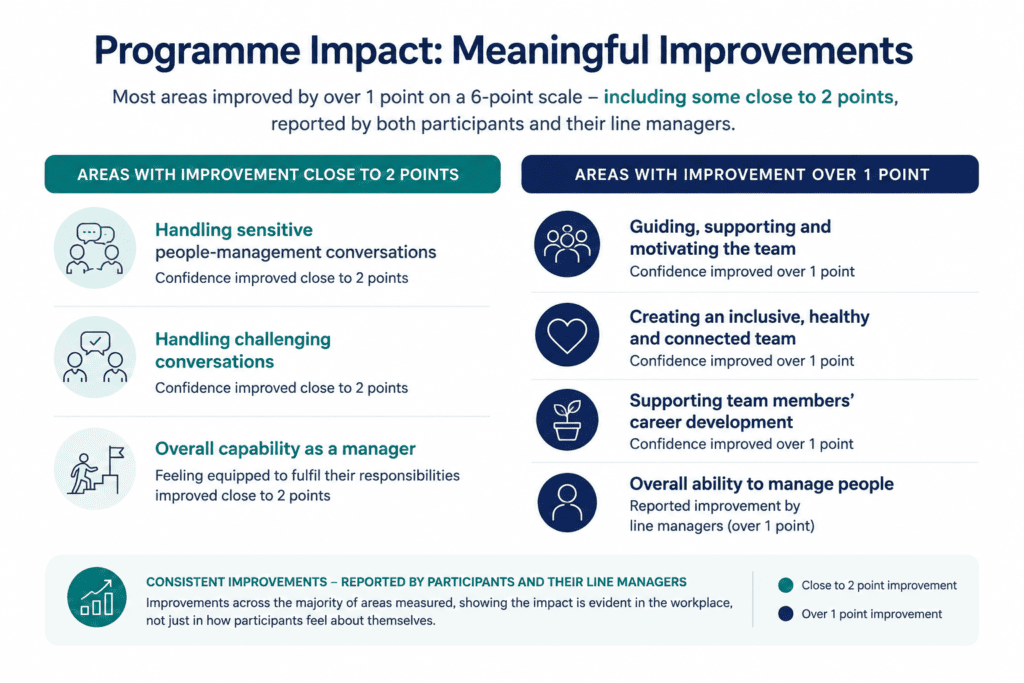
The evaluation results have been really positive. On a six-point scale, most of the areas measured by the client improved by around a whole point or more. These included managers’ confidence in guiding and motivating their teams, creating inclusive and connected teams, supporting people’s career development and having everyday management conversations.
The biggest changes were in some of the areas managers often find hardest. Confidence in handling sensitive people-management conversations improved by around two points on that six-point scale, as did confidence in handling challenging conversations. Participants also reported a substantial improvement in how well equipped they felt to fulfil their responsibilities as managers.
And importantly, it wasn’t only the participants who felt a difference. Their line managers also reported seeing improvements across the majority of areas measured, including overall ability to manage people and supporting team members with their career development.
The qualitative feedback was interesting too. People specifically mentioned the role plays, peer-to-peer coaching and real-time discussions around different scenarios as useful parts of the experience. That doesn’t prove that problem-centred learning is always better, of course, but it does suggest that people valued the opportunity to work with realistic situations rather than simply learn about management.
It’s time to think about where we start the journey, not just the destination
As learning designers, we’ve done a lot of thinking before participants ever arrive in the room. We’ve explored the problems, spotted the patterns, found useful ideas and eventually arrived at a model, framework or approach that we think will help.
The temptation is to save people the trouble and just give them what we found. But actually, allowing them to work through a similar process is where the learning happens.
Rather than beginning with “What do people need to know?”, we could spend more time thinking about the problems they need to be able to solve. What will they see happening in front of them? What will make that difficult? What do they need to notice, decide or do differently?
Then we can introduce the knowledge, models and tools at the point when they become useful – when people have the context, and have already done some of the work for themselves. Then it feels like a genuine help, not just something passively provided.
It’s a subtle shift, but I think it makes a big difference. Instead of asking people to learn our solution and then work out where it fits, we start in their world and help them make the journey towards a solution themselves. The learning is far more likely to stick, and be applied back in their role, and surely what we want learning to achieve in the first place.
If you’re thinking about developing a programme and would like to explore what a more problem-centred approach could look like in your organisation, get in touch. I’d be happy to talk through the challenges your people actually face and how we could build the learning around them.
You must be logged in to post a comment.